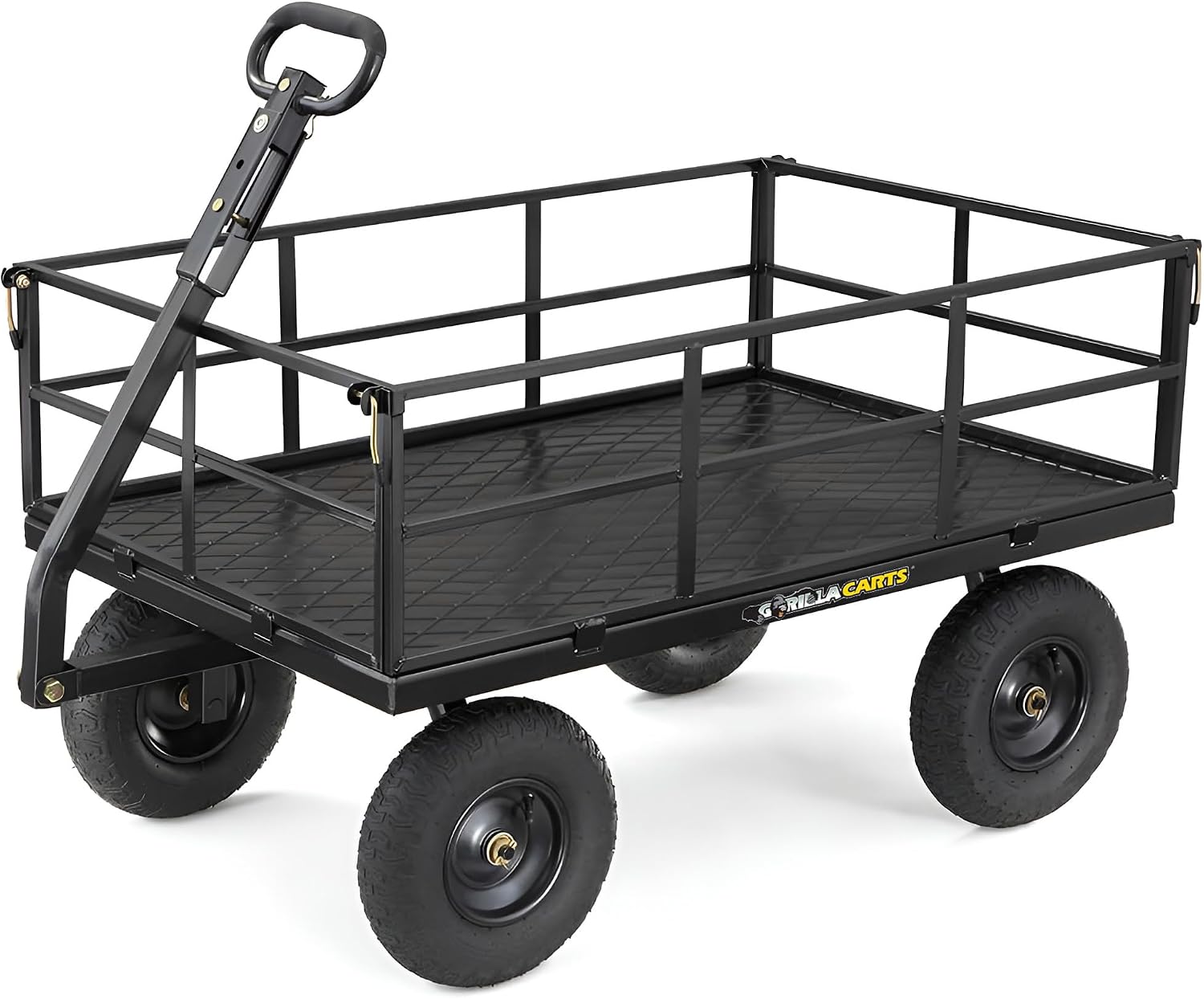
The best garden cart for heavy loads isn’t the one with the biggest tub — it’s the one that won’t collapse under wet soil, firewood, or a stack of pavers. Most carts marketed as “heavy-duty” have thin steel frames, plastic wheels, and axles that bend the first time you hit a rut.
I’ve hauled rocks, mulch, and 300-pound feed bags through mud, gravel, and garden paths. The right cart comes down to frame gauge, tire type, and a handle that won’t twist. Below, I’ll walk you through the models that actually hold up.
📌 Why You Need a Heavy-Duty Garden Cart for Big Hauling Jobs
If you’re hauling more than two or three 50-lb bags of soil, mulch, or rocks in a single afternoon, a standard wheelbarrow will fight you every step. It’s not just about arm strength—it’s about stability, tire design, and frame capacity. A heavy-duty garden cart turns a back-breaking chore into a quick, controlled trip.
Here’s what big hauling actually looks like in real yards:
- Bulk soil and compost — often 40–60 lb per cubic foot, and you rarely move just one load.
- Mulch and wood chips — wet mulch can exceed 50 lb per wheelbarrow load, but a heavy cart carries 3–4x that.
- Rocks, pavers, and gravel — sharp edges and concentrated weight shred thin plastic tubs.
- 50+ lb pet food bags, feed sacks, firewood, or bagged concrete — all awkward, dense, and easy to drop.
Standard wheelbarrows have a single front wheel, so a heavy load shifts side to side and tips on uneven ground. Lightweight garden carts typically use thin plastic frames, flimsy axles, and narrow tires that sink in soft soil or gravel. Under 150+ lb, they flex, wobble, and spill. That’s the exact moment you strain your back trying to catch the load.
A purpose-built heavy-duty cart changes the math. Look for a reinforced steel or powder-coated frame, a deep non-slip bed, and wide pneumatic or never-flat tires rated for 300–1,200 lb. The four-wheel (or dual-wheel) stance keeps weight centered, so you push instead of balancing. You’ll finish mulch runs in half the trips, with fewer spills and far less lower-back strain.
🔍 Top 5 Best Garden Carts for Heavy Loads in 2026
These five carts made my 2026 shortlist because they pair high weight ratings with tires and frame designs that hold up on rocky ground, wet grass, and repeated dumping. I’ve sorted them from a foldable 600 lb option up to a professional 1,500 lb hauler.
| Product | Weight Capacity | Tire Type | Frame Material | Price Range | Check Price |
|---|---|---|---|---|---|
| 1,200 lb Steel Mesh Utility Cart | 1,200 lb | Pneumatic all-terrain | Steel mesh | $150–$250 | Check Price → |
| 800 lb Poly Dump Cart | 800 lb | Flat-free | Poly | $120–$200 | Check Price → |
| 1,000 lb Heavy-Duty Steel Cart with Convertible Handle | 1,000 lb | Pneumatic all-terrain | Steel | $180–$280 | Check Price → |
| 600 lb Folding Garden Cart | 600 lb | Flat-free solid | Steel | $70–$120 | Check Price → |
| 1,500 lb Professional-Grade Steel Cart | 1,500 lb | Pneumatic dual-wheel | Steel | $300–$450 | Check Price → |
All links go to live Amazon listings. Prices shift often, so I’d check the current rate before committing — especially on the 1,500 lb pro cart.
📌 Heavy-Duty Garden Cart Buying Guide: Capacity, Materials, and Comfort
The heavy-duty garden cart you choose should start with capacity, then frame material, then tire and handle design. A 400–600 lb rated cart handles most weekend hauling, but if you’re moving multiple 40–50 lb bags of pet food plus wet soil, look for 800–1,000 lb capacity and a bed large enough for bulky items without stacking too high.
- Steel frames: strongest, but need powder coating to resist rust; the cart itself is heavier.
- Poly frames/beds: won’t rust, lighter, easy to clean, but can flex under extreme point loads.
- Wood frames: classic look, very sturdy, but heavy and needs sealing or it rots.
Tires matter most on uneven ground. Pneumatic (air-filled) tires roll smoothly over grass, gravel, and roots, and absorb shock, but you’ll need to check pressure and may deal with flats. Flat-free foam or solid tires are zero maintenance, but ride stiffer and can slip on loose gravel. For heavy loads, choose larger-diameter pneumatic tires with a 4-ply rating.
Handle design and wheelbase decide how safe and comfortable the cart is to steer. A D-shaped or loop handle lets you pull with both hands and turn without twisting your wrist. A longer wheelbase resists tipping under load but needs more room to turn. Keep the bed low to the ground to reduce lifting strain when loading wet soil or 50-lb bags.
📌 Weight Capacity and Tire Options Compared for All-Terrain Hauling
Weight capacity and tire choice are the two specs that separate a real hauling cart from a garden toy. The right combo depends on your terrain and the heaviest load you’ll actually move, not the absolute max you might imagine.
Pneumatic (air-filled) tires roll smoothly over rocks, roots, and uneven ground. They absorb shock better, which keeps your load stable and reduces strain on your arms. The trade-off? You’ll need to check air pressure regularly, and a puncture can sideline a full cart at the worst time.
Flat-free (solid) tires are puncture-proof for sharp debris like nails, thorns, or glass. Zero maintenance and no flats sounds great, but the ride is noticeably firmer. On rough terrain, you’ll feel every bump through the handle.
Typical heavy-duty carts come in these weight classes:
- 600 lb – ideal for mulch, leaves, soil, and light garden debris.
- 800 lb – handles firewood, bagged stone, and most yard cleanups.
- 1,000 lb – built for gravel, sand, pavers, and serious landscaping.
- 1,200+ lb – commercial or homestead use, often featuring dual wheels and reinforced frames.
Wheel diameter and wheelbase matter just as much as capacity. Larger diameter wheels climb over obstacles instead of hanging up, while a wider wheelbase keeps the cart from tipping when you hit a rut or turn with a full load. If you haul on slopes or rough trails, prioritize wheel size over raw pound rating.
🔑 How to Maintain Your Garden Cart for Long-Term Heavy Use
A heavy-duty garden cart lasts years longer if you treat it like the hauling tool it is—not a garage ornament. I’ve seen rusty axles and cracked tires kill otherwise solid carts within two seasons. Here’s the routine I follow after every big load and before each heavy session.
- Clean after hauling soil, mulch, or fertilizer. Rinse the tub and frame with a garden hose, then wipe with mild dish soap and water. Fertilizer residue is corrosive, especially on steel hardware. Let it air dry completely before folding or storing.
- Check and inflate pneumatic tires to the recommended PSI. Most garden cart tires run 20–30 PSI; the exact number is printed on the sidewall. Underinflated tires increase rolling resistance, wear sidewalls, and can pinch-flat under heavy loads. Top them off before every heavy hauling session.
- Lubricate wheels, axles, and pivot points seasonally. I use a spray white lithium grease on metal pivot joints and a silicone lubricant on plastic bushings. This prevents squeaking and seizing, especially if you haul near sandy or dusty soil. Wipe off excess so it doesn’t attract grit.
- Store indoors or cover it. UV light breaks down plastic tubs and rubber tires; moisture rusts steel frames and hardware. If you can’t park it in a shed, use a breathable cart cover. Avoid tight plastic tarps that trap condensation.
That’s it. Ten minutes of upkeep after heavy use beats a snapped axle or a seized wheel mid-haul.
❓ FAQ: Common Questions About Heavy-Duty Garden Carts and Heavy Loads
How much weight can a heavy-duty garden cart hold?
Most heavy-duty models carry 600 to 1,200 pounds, while light-duty carts top out around 300 pounds. Check both the tub capacity and the tire load rating — a 1,000-pound tub doesn’t matter if the wheels fail first.
Are pneumatic or flat-free tires better for heavy loads on uneven ground?
Pneumatic tires absorb bumps better and roll easier over rocks and roots, but they can go flat. Flat-free tires can’t puncture, yet they ride rougher. For heavy loads on rough terrain, I prefer pneumatic tires with a thick sidewall.
Can I use a garden cart to haul bags of pet food or animal feed?
Yes. A 40- to 50-pound feed bag is well within capacity. Use a cart with a solid tub or high sides to keep bags stable, and cover open loads if you’re hauling in rain.
What is the best material for a heavy-load garden cart frame?
Powder-coated steel frames are the strongest for repeated heavy loads, though they’re heavier. Aluminum resists rust but costs more. Avoid thin plastic frames if you regularly haul over 300 pounds.
Do I need brakes on a garden cart for heavy loads?
Brakes aren’t essential on flat ground, but they’re worth it on slopes. A foot-operated brake or parking brake stops a loaded cart from rolling while you unload feed bags or soil.
How do I prevent the cart from tipping when hauling heavy or tall loads?
Keep the heaviest items low and centered over the axle. Strap tall loads down, and don’t stack bags above the tub’s top edge. A wider wheelbase also adds stability on uneven ground.