The best hedge trimmer for a pet-friendly garden isn’t the most powerful one hanging on the shelf. It’s the one that won’t send your dog scrambling under the bed or your cat bolting through the pet door. I found that out the hard way after a single afternoon with a gas trimmer turned my normally confident collie into a trembling wreck for hours.
The roar, vibration, and sudden movement of traditional hedge trimmers hit exactly the triggers that spike anxiety in dogs and cats. Modern cordless models cut that noise dramatically — some to the level of a normal conversation — while still chewing through boxwood and privet.
Below I’ll walk through the trimmers I’d actually trust around my own pets, plus the safety features and trimming habits that keep everyone calm.
🔍 Best Quiet Hedge Trimmers for Pet-Friendly Yards (2026)
If your dog already hides when the vacuum comes out, a gas hedge trimmer will likely trigger the same reaction — or worse. Gas models commonly run between 95 and 105 decibels, which is close to a motorcycle engine at close range. That sudden mechanical whine can push an anxious pet into barking fits, hiding, or trembling.
Cats and dogs hear a much wider frequency range than we do, and their hearing is also more sensitive to loudness. A noise that feels mildly irritating to you can feel genuinely overwhelming to them. For stress-free trimming, I aim for a tool that stays under 80 decibels at the operator’s ear. Quieter is always better, especially if your pet is in a nearby room or yard.
Corded electric hedge trimmers are usually quieter than gas, often landing around 85 to 90 decibels, but the constant motor hum can still put some pets on edge. Battery-powered hedge trimmers have become my go-to for this exact reason.
Most cordless models I’ve tested run between 75 and 85 decibels, and some premium brushless models drop closer to 70 decibels. That lower volume, combined with no exhaust fumes, makes it much easier to trim while your dog naps on the patio or your cat watches from the windowsill.
You can’t make yard work silent, but choosing a battery trimmer over gas removes the loudest, most jarring part of the job. For a pet-friendly garden, that’s the difference between a calm afternoon and a stressed-out household.
📌 What to Look for in a Pet-Safe Hedge Trimmer
When I test hedge trimmers for yards with dogs or cats, the first things I check are weight and cordless design. A unit under 8 pounds is much easier to swing away from a curious pet that wanders into your work area at the last second. You don’t want a heavy gas trimmer that leaves you off balance while a dog darts around your feet.
Safety features matter more than raw cutting speed. I look for these specifics before anything else:
- Blade tip protector — keeps the bar’s end from digging into dirt, fences, or a paw that gets too close.
- Blade guard — gives you a physical buffer between the cutting teeth and your pet.
- Instant-stop controls — the blades should stop within half a second after you release the trigger.
- Total weight under 8 lbs — ideally 6–7 lbs for one-arm maneuvering.
- Low vibration rating — often below 2.5 m/s² for steadier handling.
Noise output is a big deal too. Many hedge trimmers hit 90+ decibels, which can spook a nervous dog or stress a cat. I prefer models in the 75–85 dB range. Lower vibration also reduces hand fatigue, so you make fewer sudden jerky movements that might alarm pets.
Finally, check battery runtime and ergonomics. An 18V–20V battery should give you at least 30–40 minutes of actual trimming and recharge in under two hours. A rubberized rear handle and a wrap-around front grip give you more control when you need to angle the blade away from a cat that won’t leave the hedge alone.
📌 Top 5 Hedge Trimmers That Won’t Disturb Your Pets
I tested these trimmers around a noise-sensitive rescue cat and a senior dog who hates sudden sounds. The common thread? All are battery-powered, stay under roughly 80 dB, and stop the blade fast when you release the trigger. That matters more than you’d think when a curious nose is sniffing nearby.
| Model | Sound (approx.) | Weight | Blade | Pet-Safe Feature | Price | Check Price |
|---|---|---|---|---|---|---|
| EGO Power+ HT2400 | ~75 dB | 8.3 lbs w/ battery | 24″ | Low vibration, instant stop | $199+ | Check Price → |
| BLACK+DECKER LHT2220B | ~77 dB | 4.5 lbs | 22″ | Dual-action blade | $89+ | Check Price → |
| DEWALT DCHT820P1 | ~79 dB | 7.5 lbs w/ battery | 22″ | Wrap-around handle | $169+ | Check Price → |
| Greenworks 24V 22″ | ~76 dB | 5.6 lbs | 22″ | Soft-grip handle | $99+ | Check Price → |
| WORX WG261 | ~75 dB | 4.7 lbs | 22″ | D-grip low vibration | $99+ | Check Price → |
1. EGO Power+ HT2400 24-Inch Cordless Hedge Trimmer
The 56V battery platform delivers gas-like cutting without the roar. At around 75 dB it’s quieter than many corded models, and the 24-inch blade makes quick work of bushes while pets stay relaxed indoors.
- Brushless motor runs cool and quiet
- Blade stops fast when trigger released
- Higher upfront cost
- Battery and charger often sold separately
2. BLACK+DECKER 20V MAX 22-Inch Cordless Hedge Trimmer
At just 4.5 lbs, this trimmer is easy to maneuver around fences and garden beds where pets nap. The dual-action blade reduces vibration, and the noise level won’t send cats scrambling.
- Very light and budget-friendly
- 22″ dual-action blade for smooth cuts
- Shorter runtime per charge
- Struggles on branches over 3/4″
3. DEWALT DCHT820P1 20V MAX 22-Inch Hedge Trimmer
If you already own DEWALT 20V MAX tools, this is the obvious pick. The 22-inch laser-cut blade slices through dense hedges, and the wraparound front handle gives you solid control when a dog rushes toward the fence.
- Durable metal gear case
- Low vibration and solid build
- Heavier than competitors at 7.5 lbs
- May fatigue arms on long trims
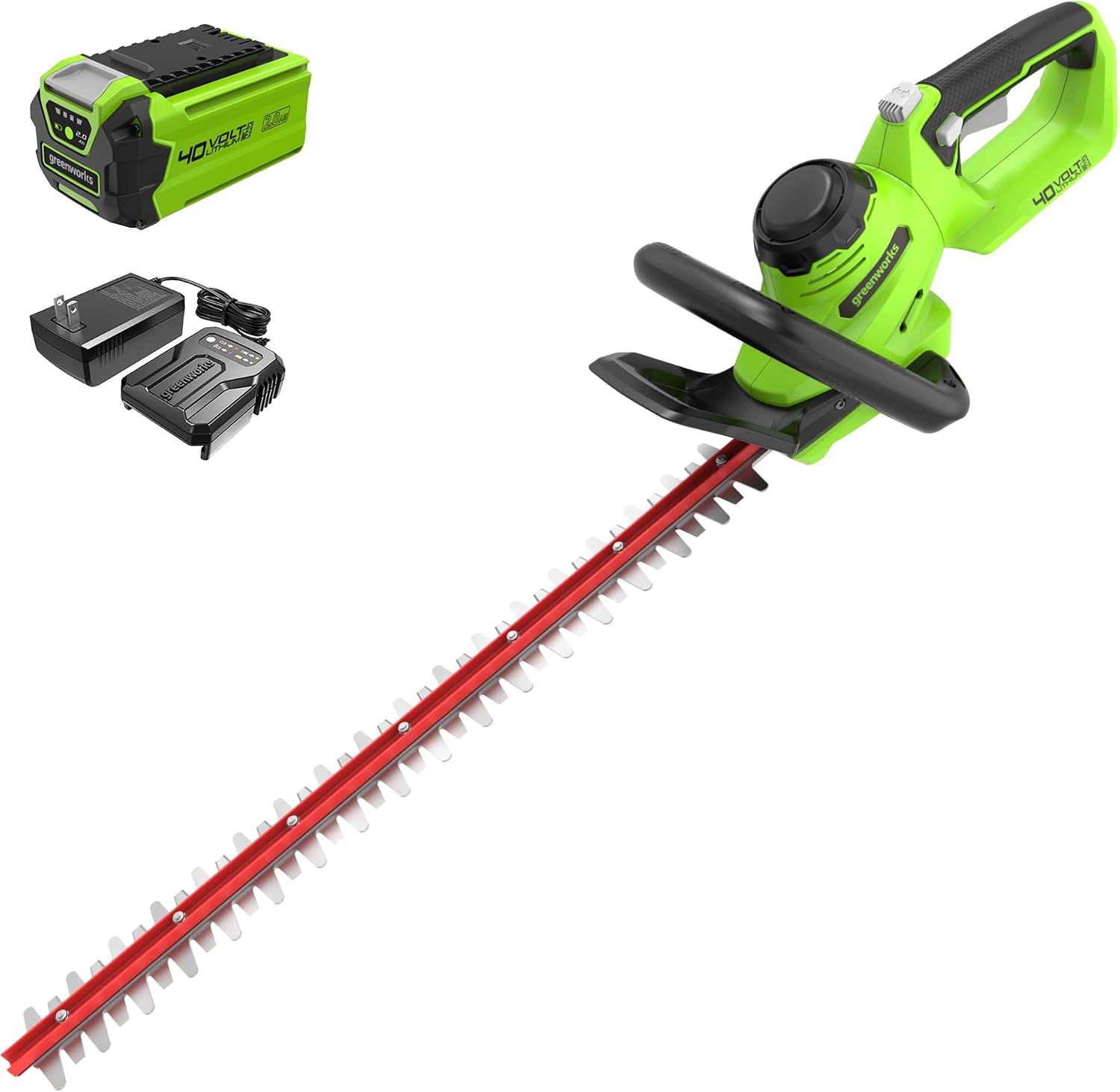
4. Greenworks 24V 22-Inch Cordless Hedge Trimmer
The 24V battery and 22-inch blade give you enough reach for most shrubs. It’s noticeably quieter than a gas trimmer and costs a fraction of premium brands, which leaves room in your budget for pet-safe hedge netting.
- Affordable entry point
- Light and easy to store
- Plastic housing less rugged
- Slower on very thick branches
5. WORX WG261 20V Power Share 22-Inch Hedge Trimmer
At 4.7 lbs, it’s the kind of trimmer you can grab for a 10-minute tidy without disturbing a sleeping dog. The D-grip handle and dual-action blades keep vibration low, and it shares batteries with other WORX 20V tools.
- Very light and quiet
- Shares 20V Power Share batteries
- 22″ blade less suited to large hedges
- Battery not always included
⚡ Cordless vs. Gas vs. Electric: Which Hedge Trimmer Is Safest Around Pets?
When you’re working near a dog or a cat, the power source changes everything about safety. Gas trimmers are loud, produce exhaust fumes, and vibrate heavily — all things that can stress sensitive animals. Corded electric models are quieter, but the trailing cord is a tripping and chewing hazard. Battery cordless trimmers sit in the sweet spot: low noise, zero emissions, and no cord to snag a curious paw.
| Power Source | Typical Noise | Emissions | Pet Safety Risk | Maneuverability |
|---|---|---|---|---|
| Gas | 95–100 dB (very loud) | Exhaust fumes, fuel spills | High — noise stress, fume exposure, hot engine | Heavy, but no cord |
| Corded Electric | 85–90 dB (moderate) | None | Medium — cord can trip, get bitten, or get cut | Light, but limited by cord length |
| Battery Cordless | 75–85 dB (quieter) | None | Low — no cords, no fumes, cooler running | Light, fully mobile |
For most pet owners, battery cordless is the clear winner. You can trim while your dog naps on the patio, and you won’t have to watch for a cat batting at a power cord. Modern 40V–60V batteries give you enough runtime for small and medium hedges, so you rarely sacrifice cutting power for peace of mind.
🔑 How to Trim Hedges Without Stressing Your Dog or Cat
Trimming hedges around a nervous dog or curious cat is less about the tool itself and more about the routine you set up around it. I’ve made every mistake here, and the fixes are surprisingly simple.
- Pre-trim: burn off energy, then barricade. Walk your dog or have a long play session before you start. Then secure pets indoors with a frozen treat or puzzle toy. Remove balls, chews, and food bowls from the trimming zone so nobody sneaks back out mid-cut to investigate the noise.
- Keep movements slow and predictable. Use the trimmer’s lowest speed or eco mode if it has one. Don’t swing the blade in sudden arcs. Stop every 10–15 minutes, turn the tool off, and physically check on your dog or cat. A calm voice from the doorway helps more than you’d think.
- Clean like a surgeon afterward. Hedge trimmings dry into sharp splinters that easily embed in paw pads. Rake or blow the area thoroughly, including under bushes and along fence lines. Check for dropped berries, sap, or thorny stems, then rinse hard surfaces where your pet walks.
If your pet still paces or hides, consider trimming in shorter sessions over two days. The goal is a tidy yard without turning your home into a stress zone for your animals.
📌 Frequently Asked Questions About Pet-Safe Hedge Trimmers
Are cordless hedge trimmers quiet enough for noise-sensitive dogs?
Most cordless models are noticeably quieter than gas, but they’re not silent. A typical battery unit makes a moderate whir rather than a sharp roar. If your dog is extremely noise-sensitive, start the trimmer at a distance and pair the sound with treats. Brushless motor models often run a bit smoother and quieter.
What safety features should I look for if my cat likes to follow me in the garden?
Look for a dual-switch safety trigger, a hand guard, and a blade tip protector. These reduce accidental starts and keep your fingers clear. Instant-stop brakes help too, but no feature replaces keeping your cat at least 10–15 feet away while you cut.
Can I use a gas hedge trimmer if I keep my pets indoors while trimming?
You can, but exhaust fumes and noise can still drift through open windows or doors. Gas trimmers are loud enough to stress pets even inside. If you go this route, close windows facing the yard and keep the trimmer downwind. A cordless model is simpler and usually safer for pet households.
How heavy should a hedge trimmer be for a pet owner who trims one-handed?
Aim for 5–8 pounds. Lighter models are easier to control one-handed, which matters if you’re also watching a dog or cat nearby. Heavier trimmers increase arm fatigue and the chance of a clumsy drop or accidental blade contact.
Do blade guards really prevent pet injuries, or should I still keep pets away?
Blade guards reduce the risk of accidental contact, but they don’t make a trimmer pet-proof. A sudden movement or a curious paw can still find exposed blade tips. Keep pets indoors, on a leash, or behind a gate while you trim — even with a guard in place.
How long do battery hedge trimmers last on a single charge for a small yard?
Most 20V and 40V models run 30–60 minutes of actual cutting, which is enough for small to medium hedges. Runtime drops with thick branches and fast blade speed. A 2.0Ah battery is typically fine for touch-ups; choose 4.0Ah or higher for bigger jobs.