
The push mower vs self propelled debate really comes down to one thing: how much sweat you want to spend on your lawn each week. A standard push mower asks you to do all the work—every step, every hill, every thick patch of fescue.
A self-propelled mower gives the wheels their own drive, so you just steer. That difference matters more than you might think when you’re mowing a half-acre yard in July heat or fighting a sloped backyard.
I’ve spent hundreds of hours behind both types. The truth? Neither is universally better. your lawn size, terrain, and physical strength should pick the winner. Below I’ll break down exactly what each mower does, how they compare side by side, and which one fits your yard—not your neighbor’s.
📌 What Is a Push Mower and How Does It Work?
A push mower is any mower without a drive system — you supply all the forward motion. That covers two distinct styles: manual reel mowers with spinning cylinder blades, and standard gas or electric rotary mowers that cut grass but don’t propel themselves.
On a reel mower, the wheels turn the cutting reel as you push. On a gas or cordless push mower, the engine or motor spins the blade, but your legs handle every inch of movement. That’s the core trade-off: simpler parts and less weight, but more physical effort in thick grass or on slopes.
Push mowers perform best on flat lawns under about 5,000 square feet — think small city lots, tidy suburban yards, or narrow side strips. Once you’re mowing a quarter acre or dealing with noticeable grades, a self-propelled drive saves real energy.
Expect to pay $80–$200 for a manual reel mower, $200–$400 for a gas push mower, and $150–$350 for a cordless electric push model. They’re usually cheaper than comparable self-propelled versions because there’s no transmission, drive belt, or extra motor.
Basic maintenance is straightforward:
- Sharpen or replace the blade once a season.
- Clean grass clippings from the deck after each use.
- Change oil and air filter on gas models every 25–50 hours.
- Adjust reel-to-bedplate clearance on manual reel mowers.
📌 What Is a Self-Propelled Mower and Its Key Features?
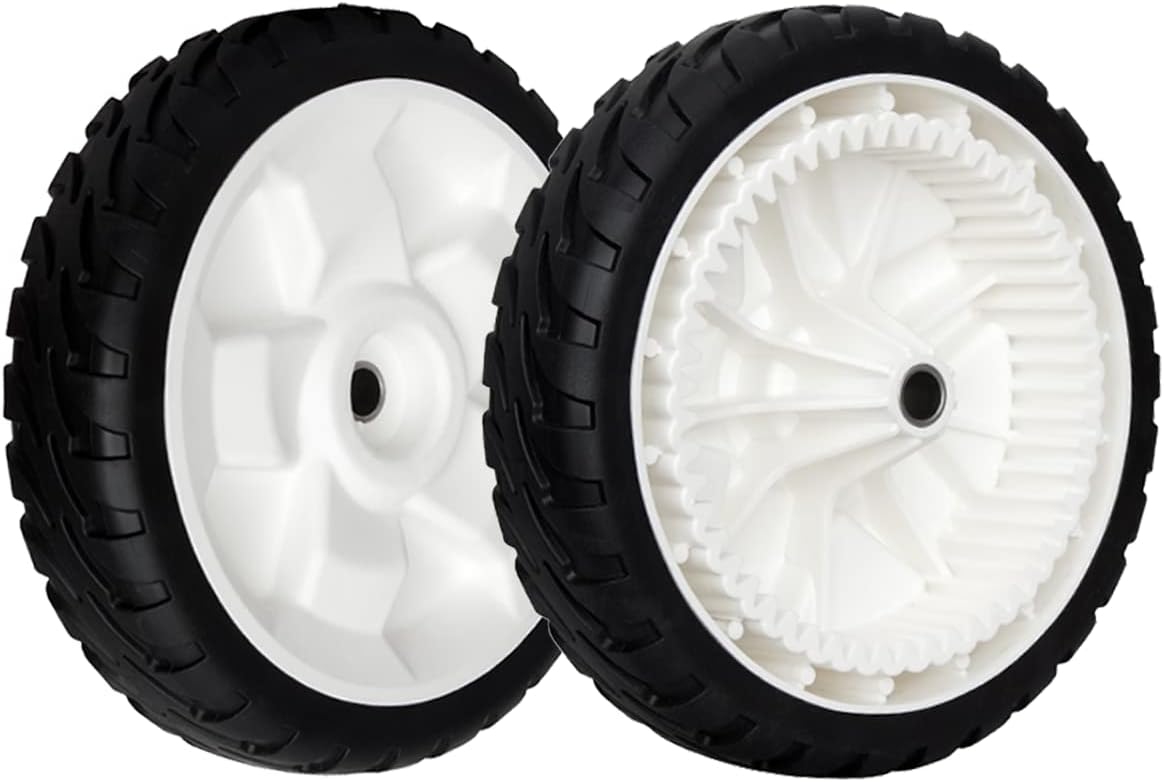
A self-propelled mower uses a drive system to turn the wheels, so the engine does the pushing for you. You just squeeze the drive bar and steer. It’s a big help on slopes and larger lawns where a standard push mower becomes a workout.
The drive system on most models falls into three groups:
- Front-wheel drive: Good for flat, open yards. It’s easier to lift and turn because the driving wheels are in front.
- Rear-wheel drive: Better traction on inclines and uneven ground. The back wheels stay planted even when the grass bag gets heavy.
- All-wheel drive: The most capable option for steep, bumpy, or damp terrain. It grips from all four wheels, though it adds weight and cost.
Speed control on many models is a simple lever or dial. Some mowers let you adjust walk speed while the blade stays at full cutting speed. Others run at one fixed pace. Blade engagement is usually separate, so you can stop the blade without shutting off the engine.
Self-propelled mowers typically cost $350 to $1,200. You’ll also deal with extra maintenance: drive belts, transmission lubrication, and cable adjustments. They’re heavier than push mowers, but the extra weight is a fair trade for less pushing effort on hilly or half-acre yards.
⚡ Push Mower vs Self Propelled: Key Differences Compared
The core difference is simple: you push a push mower, while a self-propelled mower drives its wheels for you. That one mechanical change affects everything from cost to how tired you’ll feel after mowing.
| Factor | Push Mower | Self-Propelled Mower |
|---|---|---|
| Typical cost | $150–$400 | $300–$900+ |
| Weight | Often 40–70 lb | Usually 70–100 lb or more |
| Maneuverability | Lighter and easier to pivot around beds | Heavier, but drive wheels help on slopes |
| Effort required | All forward motion comes from you | You guide the mower; wheels do the work |
| Best lawn size | Small to medium, mostly flat yards | Medium to large yards, inclines, or uneven turf |
| Maintenance | Simpler — fewer moving parts | Extra drive belt, cable, or gearbox to service |
On price, a decent push mower often runs $150–$400. Self-propelled models start around $300 and climb past $900 once you add larger decks, variable speed, or electric drive systems. You’re paying for less physical work, not necessarily a better cut.
Weight and maneuverability trade off quickly. Push mowers are lighter and easier to flick around tight corners, flower beds, and fences. Self-propelled units feel heavier, but they track better on slopes and long straight runs because you aren’t fighting gravity and the machine at the same time.
Think about exercise versus convenience. A push mower gives you a better workout and keeps the price down. A self-propelled mower may be the smarter choice if you mow more than half an acre, deal with hills, or want to finish without a sore back.
⚡ Push Mower vs Self-Propelled: Pros and Cons
The real trade-off isn’t cut quality—it’s how much effort you want to put in and what your yard throws at you. A push mower saves money and weight. A self-propelled mower saves your legs on hills and long stretches.
- Lower upfront cost—most decent models run $150–$300.
- Lighter frame makes it easier to turn around beds and trees.
- Simpler maintenance: no drive belt, gearbox, or transmission to service.
- You supply all the forward motion, which wears you out in thick grass.
- Slower on half-acre or larger lawns and steep slopes.
- Can be rough on your back if the yard has lots of uneven ground.
- Less fatigue—the drive system pushes while you steer.
- Faster mowing on big, open lawns and gentle hills.
- Better traction when grass is damp or the ground is soft.
- Higher cost—expect to pay $350–$800+ for a reliable model.
- Heavier, which can be harder to lift into a shed or truck.
- More moving parts means more potential repair bills down the road.
🔑 How to Choose Between a Push and Self-Propelled Mower
Start with your lawn’s square footage and slope. Under 1/4 acre and mostly flat? A push mower keeps things simple. 1/4 acre or larger, or any noticeable hill? A self-propelled model will save your legs and your patience.
Physical ability matters just as much. If you mow weekly or have knee, back, or stamina concerns, the self-propelled drive takes most of the work out of the job. Young, fit users with a small yard can happily push for years.
Budget is the next filter. Expect to pay roughly $150–$400 for a solid push mower and $300–$700 for a self-propelled unit. Long-term, the push mower has fewer moving parts and slightly lower repair costs, but the self-propelled transmission rarely fails if you keep the drive cable adjusted.
- Slopes over 15 degrees: choose self-propelled, especially rear-wheel drive.
- Many trees, beds, or tight corners: a lighter push mower is easier to maneuver.
- Thick, damp grass: self-propelled maintains speed without you shoving.
My rule: if you dread mowing because of effort, go self-propelled. If you want a cheap, quiet-ish workout on a small flat lawn, push is still fine.
🔍 Best Push Mowers and Self-Propelled Mowers to Consider in 2026
Here are the mowers I’d actually put in my garage, split by lawn type and budget. All prices are approximate street prices and fluctuate by retailer.
| Model | Type | Deck | Best For | Approx. Price | Check Price |
|---|---|---|---|---|---|
| Honda HRN216PKA | Gas push | 21″ | Small, flat lawns | $499 | Check Price → |
| Troy-Bilt TB110 | Gas push (budget) | 21″ | Small yards under 1/4 acre | $249 | Check Price → |
| Toro Recycler 22″ Personal Pace | Gas self-propelled | 22″ | Large or sloped yards | $429 | Check Price → |
| Honda HRX217VKA | Gas self-propelled (premium) | 21″ | Large slopes, thick grass | $799 | Check Price → |
| EGO Power+ LM2135SP | Battery self-propelled | 21″ | Low maintenance, medium yards | $649 | Check Price → |
⚡ FAQ: Push Mower vs Self Propelled
Is a self-propelled mower worth the extra money?
For most yards over 1/4 acre or with noticeable slopes, yes. You’ll pay $100–$250 more for a drive system that does the hard pushing, and it cuts mowing fatigue significantly on weekly cuts.
Can a push mower handle a hilly yard?
A lightweight push mower works on gentle slopes, but anything beyond 10–15 degrees becomes a real leg workout. For moderate hills, go self-propelled—rear-wheel drive grips best on inclines.
Do self-propelled mowers need more maintenance?
Slightly. The drive belt, transmission, and wheel gears add moving parts. You’ll replace a belt every few seasons and check cable tension monthly. Gas push mowers have fewer failure points but still need engine care.
Are electric push mowers easier to push than gas models?
Usually, yes. Battery mowers weigh 35–60 lbs while gas push mowers run 60–90 lbs. Less weight and no engine drag make them feel lighter. On thick grass, you still supply the forward force.
What lawn size is too big for a push mower?
Anything over 1/2 acre (roughly 20,000 sq ft) gets tedious with a push mower. Between 1/4 and 1/2 acre, a self-propelled model saves real time. Below 1/4 acre, a push mower is fine.
Can you turn off the self-propelled feature and push manually?
On many models, yes. Most have a bail or lever that disengages the drive. But the mower is heavier, so pushing it manually takes more effort than a dedicated push mower.
4 thoughts on “Push Mower vs Self Propelled: Which Mower Fits Your Lawn? (2026 Guide)”